
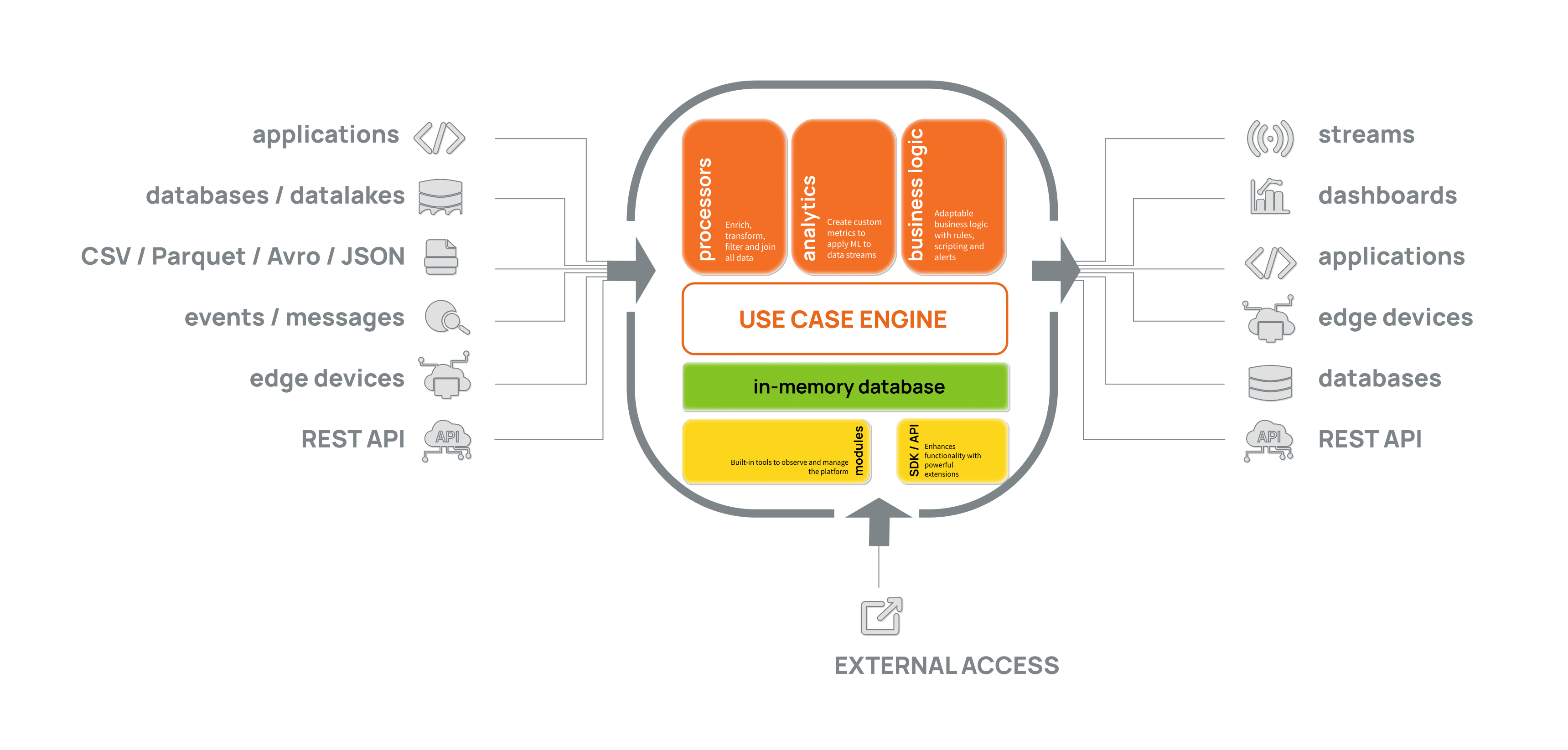
Use case development steps
The Joule platform includes a low-code development environment that reduces complexity by using a high-level domain-specific language (DSL). With human-readable YAML syntax, teams can easily define use cases, connect data sources, and build metrics and analytics without the overhead of traditional coding.
Define the use case objective
A use case is defined by combining source data requirements, processing pipeline, and output destinations into a single cohesive definition
Define processing pipeline
A stream defines the processing requirements and the sequence in which they occur.
Subscribe to data sources
Connect and subscribe to external data streams effortlessly with source connectors.
Define output destinations
Seamlessly deliver events to downstream systems with destination connectors
Deploy the use case
Use the Joule CLI tool to deploy pipelines, data connections and use cases quickly.
Getting started
Learn how to build and deploy use cases using Joule low-code platform.
Learn to build a Joule locally and run a first banking real-time streaming use case.
Learn to use filters, enrichment, user defined alerts, and data connectors.
Define and deploy a set of sliding window analytics using out-of-the-box analytic features.
Advanced tutorials
Progress beyond simple use cases by developing custom processors and analytics.
Build, deploy and apply a custom missing value processor to provide consistent values over time.
Learn how to create a custom Bollinger band implementation using the user defined function API and apply it within a use case context.
Apply proactive adaptive control to remote connected devices using a centralise control process.
Support
Email us when you need support or need to bounce ideas when creating Joule use cases.